
W210 vs W240 vs W320 Cashews Which Grade Should You Buy
When buying whole cashews, you may come across names such as W210, W240 and W320. These grades help buyers understand the approximate size of the kernels and select cashews for their intended use.
A retailer may want large, visible kernels for a premium display, while a sweet shop may need a consistent whole cashew for garnishing. Understanding the difference can help you discuss your requirements with a cashew nut manufacturer or supplier.
What Is the Difference Between W210 W240 and W320 Cashews?
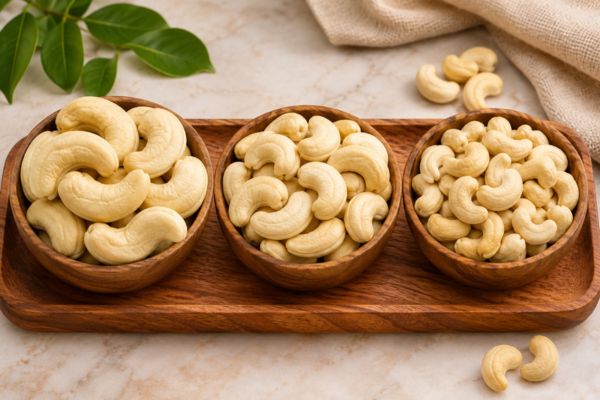
| Cashew Grade | Relative Kernel Size | Common Selection |
|---|---|---|
| W210 | Largest of the three | Premium displays and whole-cashew packs |
| W240 | Medium to large | Retail packs, serving and garnishing |
| W320 | Smaller than W210 and W240 | Everyday snacking, retail and food preparation |
Size alone does not tell you everything about a cashew. Check the product specification, appearance and packaging before making a purchase.
What Does the W in Cashew Grades Mean?
The letter W indicates a white whole cashew grade. The number that follows is used to identify its size category.
For example, W240 refers to a whole white cashew grade with a kernel count associated with that grade. Actual kernels can vary in size, so buyers looking for a particular appearance should request a sample or specification.
W210 Cashews for a Larger Kernel
W210 cashews are the largest of the three grades compared here. Their size makes them a suitable option when the whole kernel will be clearly visible.
You may consider W210 cashews for:
- Premium dry fruit packs
- Whole-cashew displays
- Serving trays
- Products where a larger kernel is preferred
For a retail pack, compare a sample with your packaging size. A larger kernel can give the pack a different appearance from a pack of smaller whole cashews.
W240 Cashews for a Medium to Large Whole Kernel
W240 cashews are generally smaller than W210 but larger than W320. They offer a whole-kernel appearance that can suit several retail and food uses.
W240 cashews can be considered for:
- Packaged dry fruit products
- Serving bowls and snack mixes
- Garnishing sweets and desserts
- Products where a medium to large kernel is preferred
If you are choosing between W210 and W240, place samples side by side in your intended container. The comparison can help you decide which size creates the look you want.
W320 Cashews for Everyday Use
W320 cashews are smaller than W210 and W240, while still being a whole white cashew grade. They can be used in retail packs, snacks and recipes where a medium-sized kernel is suitable.
Common uses include:
- Everyday snacking
- Roasting and seasoning
- Retail dry fruit packs
- Cooking and food preparation
- Garnishing dishes
If the cashews will be chopped or ground, consider whether a whole grade is necessary for your recipe. A suitable broken grade may also be worth discussing with your supplier.
How to Choose the Right Cashew Grade for Your Business
Start with the role the cashew will play in your final product. A kernel displayed on top of a sweet has a different job from one that will be blended into a sauce.
| Your Requirement | What to Consider |
|---|---|
| A prominent whole kernel | Compare W210 and W240 samples for size and appearance. |
| A medium whole cashew for retail | Review W240 and W320 alongside your pack design. |
| Garnishing sweets or desserts | Select a size that fits the portion and creates the look you want. |
| Roasting and seasoning | Discuss the required kernel size and consistency with your supplier. |
| Grinding or chopping | Compare whole and suitable broken grades for your recipe. |
Your final choice should also reflect the quantity, product specifications and customer preferences.
Does a Larger Cashew Grade Mean Better Quality?
A larger cashew is not automatically better for every use. W210, W240 and W320 describe size categories; buyers should also assess other quality factors.
When comparing samples, check:
- Whether the kernels match the stated grade
- Their appearance and consistency
- The smell and taste, when appropriate
- The condition of the packaging
- The best-before date and storage instructions
A medium-sized cashew may be the right choice for a product that needs smaller whole kernels. Choose the grade that fits your application.
Are W210 W240 and W320 Cashews Different in Taste?
The grade number primarily describes size. Taste and texture can also be influenced by the product’s freshness, processing, roasting and storage conditions.
If flavour is important for your product, compare samples prepared in the same way. For example, taste plain samples together before deciding which grade to use in a roasted snack.
What Should You Ask a Cashew Nut Supplier?
Before placing an order, give your cashew nut supplier as much detail as possible about how you plan to use the product. This helps both parties discuss a suitable grade and specification.
Ask about:
- Grade availability: Are W210, W240 and W320 available in the quantity you need?
- Product specification: What kernel count and appearance should you expect?
- Samples: Can you review a sample before confirming a bulk order?
- Packaging: How will the cashews be packed for delivery?
- Storage: What conditions are recommended for the product?
- Delivery: When can the order be supplied?
For repeat purchases, keep a record of the agreed grade and specification. This gives you a reference for future orders.
Explore Whole Cashew Grades from Keshar Cashewnuts
The right cashew grade depends on how you want to use and present the kernels. W210 offers a larger appearance, W240 provides a medium-to-large option, and W320 is a smaller whole grade for a range of everyday uses.
Keshar Cashewnuts, a cashew nut manufacturer and supplier in Gujarat, offers whole cashew grades for different requirements. Explore the available products and discuss your preferred grade and quantity with the team.
Frequently Asked Questions
W210 cashews are generally larger than W320 cashews. The lower number indicates a larger whole kernel on average.
Yes. W240 cashews are generally larger than W320 cashews and smaller than W210 cashews.
The number refers to the approximate kernel count per pound associated with the grade. A lower number generally indicates larger kernels.
W210, W240 and W320 can all be considered for retail packs. The choice depends on the kernel size, appearance and pack design you want.
Yes. W320 whole cashews can be used for cooking, garnishing and snacks. Choose a grade based on how visible the cashews will be in the finished dish.
Yes. Among W210, W240 and W320, W210 is generally the largest. Review a sample to confirm that its appearance meets your needs.
You can enquire with a cashew nut supplier about bulk availability, packaging and delivery for each grade. Confirm the product specification and required quantity before ordering.
Keep cashews in a clean, dry, airtight container away from heat and moisture. Follow the storage instructions and best-before date on the pack.