
How to Choose Bulk Cashew Nuts for Your Retail Store
Buying bulk cashew nuts for a retail store takes more than comparing rates. The grade, freshness, packaging and delivery terms all affect what you can sell. For retailers in Gujarat, a careful buying process helps prevent slow-moving stock, damaged kernels and customer complaints.
Your customers may buy kaju for daily eating, family functions, sweets or gift packs. Each use can need a different size or type of cashew. Large whole kernels may suit premium packs, while smaller whole cashews can serve everyday buyers. Split and broken cashews can meet the needs of customers who prepare sweets and other foods.
Before placing an order with a bulk cashew supplier in Gujarat, check a sample, confirm the product details and calculate the full cost. This guide gives you a practical checklist to choose stock that suits your shop and your customers.
Quick answer: Before buying cashews in bulk, check the grade, kernel size, freshness, whole or broken content, packaging, batch details, net weight and delivery terms. Approve a sample and record the agreed specifications before placing the order.
Understand What Your Customers Actually Buy
Dessert Pieces Cashews are a broken cashew grade consisting of smaller pieces of cashew kernels.
Instead of maintaining the shape of a complete cashew, the kernels are available as pieces that can be conveniently used in food preparation and manufacturing.
They are particularly useful in applications where the taste and texture of cashews matter but a perfect whole kernel is not required.
For example, if a sweet manufacturer plans to mix cashew pieces inside a mithai product, using a large whole cashew and breaking it during production may not always be the most practical option.
Dessert Pieces provide another choice for such applications.
Before buying, ask:
- Which cashew packs sell fastest?
- Do customers ask for a particular grade?
- Are most purchases for eating, gifting or cooking?
- Which pack sizes do customers prefer?
- How much stock remains from the last order?
- Does demand rise during festivals or weddings?
Keep a simple weekly record of sales by grade and pack size. This helps you order based on actual demand.
For example, if your smaller everyday packs sell faster than premium gift packs, give them more space in your buying plan.
Confirm the Cashew Grade Before Comparing Prices
A quotation that says only “premium kaju” leaves too much room for confusion. Ask the supplier to name the exact grade and describe what will be supplied.
For whole cashews, grade numbers such as W180, W240 and W320 generally relate to the number of kernels per pound. A lower number usually means larger kernels. However, kernel size alone does not confirm freshness or overall quality.
| Cashew Type | Possible Retail Use | What to Check |
| Large whole cashews | Premium packs and gifting | Size, shape and whole-kernel consistency |
| Medium whole cashews | Snacking and regular retail sales | Customer demand and batch consistency |
| Smaller whole cashews | Everyday packs and cooking | Size range and suitable pricing |
| Split cashews | Cooking, baking and food preparation | Split size and amount of small fragments |
| Broken cashews | Sweets, gravies and mixed recipes | Piece size, colour and intended use |
Supplier labels can vary. If the supplier uses terms such as WW, SW or a local trade name, ask what each label means.
Compare quotations for the same agreed grade, packing and quantity. Otherwise, a lower rate may simply be for a different product.
Check a Sample Before Placing a Large Order
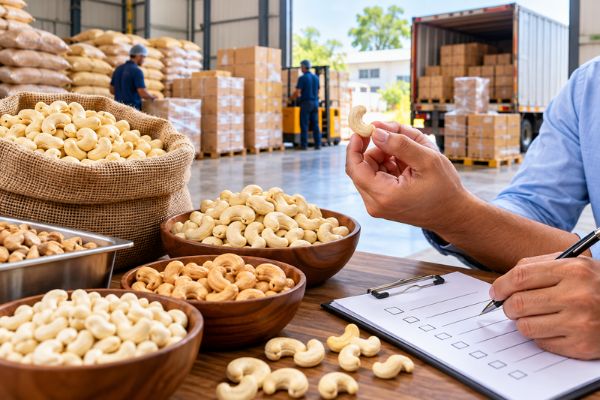
A sample lets you inspect the cashews before committing money to a full shipment.
Ask for a sample that represents the batch intended for your order. An old sample or a specially selected handful may not show what the full lot contains.
Check the sample for:
- Consistent size within the agreed grade
- Natural appearance
- Clean kernels
- Unwanted small fragments
- Unusual smells
- Signs of insects or mould
- Taste and texture
A visual check is useful, but it does not confirm every quality or food safety requirement. Ask for relevant product documents or test reports when your purchasing needs require them.
Record the sample date and grade. Where practical, keep a small sealed reference sample so you can compare it with the delivered stock.
Look Beyond Colour When Checking Freshness
Light-coloured cashews can look attractive on a retail shelf. Still, colour alone cannot tell you how fresh a batch is.
Storage, processing and packaging also affect quality. Ask the supplier about the packing date, storage instructions and stated shelf life.
Pay attention to:
- Musty or unusual odours
- Signs of moisture
- Visible mould
- Insect activity
- Damaged packaging
- Stale or unpleasant taste
If a pack shows signs of spoilage, keep it aside and contact the supplier. Do not mix questionable stock with good stock.
Retailers should also remember that a photograph cannot confirm freshness. Use product images to shortlist options, then check a sample and the shipment itself.
Agree on Whole and Broken Kernel Content
Even a pack of whole cashews may contain some broken kernels from handling and transport. The useful question is how much breakage is acceptable for your business.
If you sell premium whole-kernel packs, excess broken pieces can affect presentation and customer satisfaction.
Before ordering, confirm:
- Whether the order is for whole, split or broken cashews
- The acceptable amount of broken kernels
- The acceptable size variation
- Whether small fragments are included
- How differences will be handled after delivery
Put these points in the order confirmation. Clear specifications make it easier to discuss a problem if the delivered batch differs from the agreed sample.
Check Packaging for Transport and Storage
Cashews need packaging that protects them during delivery and storage. A low buying rate offers little value if the stock arrives in torn or poorly sealed packs.
Ask the supplier to explain the available packaging options and pack weights. Confirm whether the product comes in retail-ready packs or bulk packs for repacking.
| Packaging Check | Why It Matters |
| Food-contact suitability | Helps keep the product suitable for its intended use |
| Proper seal | Reduces exposure to moisture and outside contamination |
| Strong outer packing | Helps prevent damage during transport |
| Clear net weight | Supports stock and cost calculations |
| Batch identification | Helps trace the supplied lot |
| Storage instructions | Guides warehouse and shop handling |
Inspect the pack corners and seals when stock arrives. Check for punctures, crushed cartons and signs of water exposure.
Common Mistakes Retailers Should Avoid
Buying Only on the Lowest Rate
A cheaper batch may have a different grade, more breakage or packing that does not suit your needs. Compare the complete specification.
Skipping the Sample Check
A short product description cannot show taste, size consistency or actual appearance. Test a representative sample first.
Ordering Too Many Grades at Once
A wide range can spread your money across slow-selling products. Start with grades your customers already ask for.
Ignoring Freight and Packing Costs
Extra costs can reduce your expected margin. Calculate them before confirming the order.
Mixing Different Batches
Mixing batches makes stock rotation and complaint tracing harder. Keep batch records clear.
A Ready-to-Use Bulk Cashew Buying Checklist
| Checkpoint | What to Confirm Before Ordering |
| Customer demand | Which grade and pack size will sell? |
| Product grade | Is the exact grade written in the quotation? |
| Sample | Does it represent the intended supply batch? |
| Quality | Are appearance, smell and texture acceptable? |
| Breakage | Is the acceptable broken content agreed? |
| Packaging | Are pack weight, sealing and protection suitable? |
| Quantity | Can you sell and store the planned order? |
| Full cost | Are freight, taxes and packing included? |
| Delivery | Are dispatch and transit terms clear? |
| Records | Are invoice and batch details available? |
| Complaint process | What happens if the delivery differs? |
Discuss Your Bulk Cashew Requirements with Keshar Cashewnuts
Keshar Cashewnuts offers whole, split and broken cashew varieties from its facility in Santej, Gujarat.
Retailers can share their preferred grade, quantity, packing needs and delivery location when making an enquiry. Ask about current availability, sample arrangements and order terms before confirming a purchase.
For a useful quotation, provide:
- Your store location
- Required cashew grade or intended use
- Planned order quantity
- Preferred pack weight
- Required delivery date
- Whether you need a one-time or repeat supply
Visit Keshar Cashewnuts to view the product range or send a bulk enquiry.
Frequently Asked Questions
Check the exact grade, sample quality, freshness, kernel size, broken content, packaging, net weight and delivery terms. Confirm the full purchase cost and complaint process in writing.
Stock grades that match customer demand. Larger whole kernels may suit premium gifting, while medium and smaller whole kernels can suit regular sales. Split and broken grades can serve cooking and sweet-making customers.
Yes. A representative sample helps you judge appearance, size, taste and texture. Ask the supplier to confirm that the sample matches the batch planned for delivery.
Compare the same grade, quantity, net pack weight and packaging type. Include freight, applicable taxes and handling costs. Check delivery and payment terms alongside the rate.
Use expected sales, current usable stock, supplier lead time and storage capacity to decide. Add a reasonable buffer for demand changes, but avoid buying more than you can manage.
Keep the affected stock separate. Record the batch details, take clear photographs and contact the supplier within the agreed reporting period. Explain how the delivery differs from the approved specification.
Yes. Retailers can contact Keshar Cashewnuts with their required grade, quantity, packing needs and Gujarat delivery location. Confirm availability and supply terms before placing the order.