Cashew Quality Checklist for Retailers and Food Businesses
Checking cashew quality before buying in bulk helps you choose stock that suits your customers and recipes. A batch may look good in a photo but differ in size, freshness, taste or broken content when it arrives. For retailers and food businesses in Gujarat, these differences can affect sales, packing work and customer satisfaction.
A useful quality check starts with a clear product description and a representative sample. You should know the grade, intended use, packaging and delivery terms before confirming an order. Large whole cashews may suit gift packs, while split or broken cashews may suit cooking and food production.
The goal is to check whether the offered batch meets your needs. This guide explains what you can inspect yourself, which details to request from the supplier and how to check the shipment after delivery.
Quick answer: Before buying cashews in bulk, confirm the grade and inspect a representative sample for size, appearance, smell, texture and broken content. Check packaging, batch details and storage instructions. Visual checks cannot confirm every food safety requirement, so request suitable documents or testing where needed.
Decide What Good Quality Means for Your Business
Your intended use should guide the quality check.
A gift-pack retailer may need large, uniform whole kernels. A bakery may need pieces that mix evenly into dough. A sweet maker may care more about grinding results and the final product’s texture.
Before requesting a sample, write down:
- The product you plan to sell or prepare
- Your preferred cashew grade
- Whether you need whole kernels, splits or pieces
- The required quantity
- Your packaging needs
- Any customer or production specifications
This gives the supplier a clear starting point.
For example, “whole cashews for a premium gift box” is more useful than asking only for “best-quality kaju.”
Confirm the Exact Cashew Grade
Cashew grade names help describe size, colour category and kernel form. However, a grade label alone does not prove that the batch is fresh or suitable for your business.
Ask the supplier to confirm the full grade description in writing.
| Product Detail | What to Ask |
| Grade name | What exact grade is being quoted? |
| Kernel form | Is it whole, split or broken? |
| Size | What size range should the batch contain? |
| Colour category | How is the offered product described? |
| Broken content | What amount is acceptable? |
| Packing | What is the net weight and packaging type? |
Do not compare two quotations unless the product specifications match.
If a supplier uses a local trade name, ask for a plain description and a sample. This helps prevent confusion between similar-sounding products.
Request a Representative Sample
A sample should reflect the stock intended for your order.
Ask whether the sample comes from the available supply batch. A specially selected handful may look different from the full shipment.
When the sample arrives:
- Record the supplier and grade.
- Note the sample date and batch details, if available.
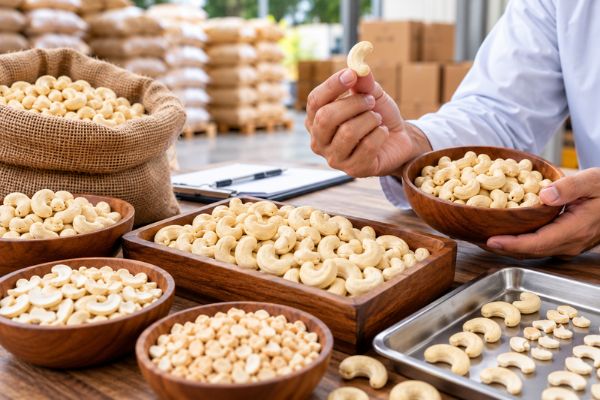
- Spread it on a clean tray.
- Inspect several kernels and pieces.
- Test it for your intended use.
- Record what you approve.
Where practical, keep a small sealed reference sample. You can compare it with the delivered stock later.
For a new supplier, a manageable trial order can also help you assess product consistency and delivery handling before increasing the quantity.
Check Kernel Size and Uniformity
Size consistency matters when cashews are visible in a retail pack or finished dish.
Spread the sample in a single layer. Look for unusual differences in kernel size within the quoted grade.
Ask yourself:
- Does the sample match the size you expected?
- Are most kernels reasonably consistent?
- Are there many smaller kernels mixed into the lot?
- Does the size suit your pack or recipe?
- Will the batch look consistent when divided into retail packs?
Natural variation is normal. The useful question is whether the variation meets your agreed specification.
For premium gift packs, test the sample in the actual tray or box. This shows how the cashews will look to the customer.
Inspect Appearance Without Judging by Colour Alone
Look at the sample under neutral lighting. Strong yellow lighting or edited product photos can make colour harder to judge.
Check for:
- Unusual spots or surface changes
- Visible mould
- Foreign material
- Insect damage
- Excess loose fragments
- Differences from the agreed product category
Cashew colour can vary with the product category and processing. A lighter kernel is not automatically fresher than a darker one.
Compare the batch with its stated specification. If the colour looks unexpected, ask the supplier to explain before approving the order.
Do not make a food safety decision from appearance alone. Some issues require suitable testing.
Smell the Sample Before Checking Taste
Smell can help you notice obvious quality problems.
Open the sample away from perfumes, spices and cleaning products. These nearby smells can make the check less useful.
Pay attention to:
- A stale or unusual oily smell
- Musty odours
- Sour smells
- Chemical or cleaning-product odours
- Strong smells picked up during storage
If the sample smells unusual, keep it aside and ask the supplier to investigate.
Do not taste cashews that show mould, pest activity or other signs of spoilage. Keep questionable samples separate from food intended for sale or preparation.
Compare Taste and Texture in the Same Form
For samples that pass the initial checks, assess taste and texture through your normal food-handling process.
Compare similar products. Plain cashews should be compared with plain cashews, while roasted products should be compared under similar conditions.
Check whether the sample:
- Has an acceptable flavour
- Matches your expected texture
- Performs well after your usual preparation
- Gives consistent results across several kernels
For a bakery, this may mean a small baking trial. For a snack business, it may mean a controlled roasting trial.
A sample that tastes acceptable on its own may still be unsuitable for a particular recipe. Test the final use before placing a large order.
Check Broken Kernels and Small Fragments
Broken content affects how much of the order is suitable for your intended use.
A whole-cashew retailer may need to separate pieces before packing. A food manufacturer buying broken cashews may need a particular piece size for even mixing.
Before ordering, agree on:
- Acceptable broken content in a whole grade
- Expected piece size in a broken grade
- Amount of small fragments
- How the product will be sampled and checked
- What happens if the delivery differs
You can sort a sample into whole kernels, larger pieces and smaller fragments to understand its composition. Record whether your comparison is based on weight or count, and use the same method each time.
Avoid setting a percentage based only on a photograph. Agree on a clear specification with the supplier.
Look for Foreign Material and Pest Activity
Spread the sample carefully and check for material that does not belong in the product.
Possible warning signs include:
- Insects or insect fragments
- Webbing
- Packaging fragments
- Stones or other foreign material
- Evidence of pest damage
Keep affected stock separate and contact the supplier. Do not remove visible contamination and assume the remaining batch is acceptable.
For businesses with formal purchasing specifications, define the inspection and testing requirements before placing the order.
Ask About Moisture and Product Testing
You cannot accurately confirm cashew moisture content by touch alone.
A kernel’s feel may raise a concern, but reliable measurement needs a suitable method. The same applies to food safety issues that are not visible.
Ask the supplier:
- Which product specifications are available?
- Are relevant test reports available for the batch?
- What test method was used?
- When was the sample tested?
- Can the report be linked to the supplied lot?
If your customer requires specific limits or documents, share those requirements before ordering.
A general report may not describe the exact batch being offered. Check the product name, date and batch reference rather than accepting a document without reading it.
Inspect Packaging and Seals
Packaging helps protect quality during transport and storage.
Check that the offered packaging suits your handling needs. A retailer repacking stock may have different needs from a food factory using full bulk packs.
| Packaging Check | Why It Matters |
| Intact seals | Help maintain the pack’s protection |
| Suitable food-contact material | Supports the intended food use |
| No holes or tears | Reduces exposure during handling |
| Clean, dry outer packing | Helps identify transport or storage problems |
| Clear net weight | Supports quantity checks |
| Batch details | Help trace the supplied stock |
Ask how opened packs should be stored. Once a protective pack is opened, its storage conditions may change.
Review Batch Details and Storage History
Product records support quality checks and complaint handling.
Ask for the details available for the offered product, including:
- Batch or lot identification
- Packing date
- Stated shelf life or best-before date
- Storage instructions
- Product specification
- Supplier invoice details
If you need a certain amount of remaining shelf life at delivery, agree on it before ordering.
Also explain your expected stock turnover. A shop that sells the batch quickly may have different packing needs from a buyer holding it for a longer period.
Test the Cashews in Your Actual Product
A practical trial helps you judge whether the sample works for your business.
| Buyer Type | Useful Sample Trial |
| Dry-fruit retailer | Pack the sample in the intended retail pouch |
| Gifting business | Arrange it in the selected gift box |
| Bakery | Test it in a small recipe batch |
| Sweet shop | Check grinding and finished-product results |
| Restaurant | Try it in the planned dish |
| Snack manufacturer | Run a small, controlled preparation trial |
Record the result. If you change the grade, repeat the trial rather than assuming the product will behave exactly like your previous stock.
Compare Quality and Full Purchase Cost Together
A low rate can be less useful if the batch needs extra sorting or contains more unusable stock.
Compare:
- Product specification
- Sample approval
- Usable quantity
- Packing quality
- Freight and handling charges
- Delivery terms
- Complaint process
Ask for a written quotation with the complete details.
For retailers in Ahmedabad, Gandhinagar, Surat, Vadodara and other parts of Gujarat, confirm delivery arrangements for the exact store location. Transport conditions and handling can affect the condition of the stock on arrival.
Check the Shipment After Delivery
An approved sample does not replace shipment inspection.
Check the goods promptly and within the agreed reporting period. Inspect representative packs from different parts of the shipment rather than relying on one carton.
Delivery Quality Checklist
- Match the grade with the order.
- Count the packs.
- Check net weight using a suitable scale.
- Inspect packaging and seals.
- Compare samples with the approved reference.
- Record batch details.
- Photograph any damage or differences.
- Report concerns promptly.
Keep affected stock separate while the supplier reviews the issue. Clear records make the discussion easier.
Common Cashew Quality Checking Mistakes
Buying from Photos Alone
Photos help show the product, but they cannot confirm taste, smell or the condition of the supply batch.
Treating Large Size as Proof of Quality
Size and freshness are separate buying factors. Check both.
Skipping a Recipe Trial
A suitable-looking sample may not perform as expected in your product.
Accepting Unclear Grade Names
Ask for the exact description and agreed specifications.
Ignoring Shipment Inspection
Damage or differences may occur between sample approval and delivery.
A Ready-to-Use Cashew Quality Checklist
| Checkpoint | What to Confirm |
| Intended use | Grade suits the pack or recipe |
| Grade description | Written clearly in the quotation |
| Sample | Represents the planned supply |
| Size | Matches the agreed category |
| Appearance | Meets the specification |
| Smell | No unusual odours |
| Taste and texture | Acceptable after initial checks |
| Broken content | Within the agreed requirement |
| Foreign material | No visible contamination |
| Testing | Required documents are suitable and relevant |
| Packaging | Clean, dry and intact |
| Batch records | Available for tracing the order |
| Delivery | Matches the approved specification |
Discuss Bulk Cashew Quality with Keshar Cashewnuts
Keshar Cashewnuts offers whole, split and broken cashew varieties from its facility in Santej, Gujarat.
Share your intended use, preferred grade and quality requirements when making an enquiry. Ask about sample arrangements, available specifications, packaging and current supply terms.
For a clear buying discussion, provide:
- Your business type and location
- Required cashew grade
- Planned order quantity
- Preferred pack weight
- Intended use
- Required delivery date
Visit Keshar Cashewnuts to view the product range or send a bulk enquiry.
Frequently Asked Questions
Confirm the grade and inspect a representative sample for size, appearance, smell, texture and broken content. Review packaging and batch details, then test the sample for your intended use.
No. Larger size may suit presentation, but it does not prove freshness or food safety. Check the batch condition and product specifications separately.
Colour is one part of the check. Compare it with the stated product category, but also inspect smell, texture, packaging and batch details.
Samples are especially useful for new suppliers, new grades or changed specifications. For repeat orders, agree on a quality-control process and inspect each delivery.
Touch alone cannot give an accurate moisture reading. Request suitable measurements or testing when moisture limits are part of your purchase requirements.
Separate the affected stock, record the batch details and take clear photographs. Contact the supplier within the agreed reporting period and explain the difference.
Ask about the exact grade, sample quality, acceptable breakage, packaging, batch records, storage instructions and delivery terms. Confirm the agreed details before placing the order.